Courses and Timetable
Topics
The StAR School is a summer school on modern research in mathematical general relativity aimed at Ph.D. students but applications are welcome from postdocs and advanced Master's students. The summer school will have lectures and problem sessions to guide students through a selection of topics essential to research in mathematical general relativity. These will be the following:
- Grigorios Fournodavlos: 3+1 gauges for the Einstein equations, local well-posedness and further applications We will review different formulations of the Einstein equations, based on a 3+1 splitting of the metric, and study their local well-posedness. The course will mostly focus on the ADM system and the different gauge choices available, such as Gaussian time, maximal/CMC folations, Fermi-Walker propagated frames. Each framework relies on the ability of deriving energy estimates, as well as recovering the Einstein equations in the end. Various modifications and tricks are employed in each case, which exploit the geometric structure of the equations.
- James Lucietti: Black hole uniqueness theorems. One of the most celebrated results in general relativity is the black hole no-hair theorem (or conjecture). In physical terms, this states that any isolated, equilibrium, black hole is specified by just two numbers: its mass and spin. This is a striking result since it shows that, no matter how a black hole was formed during the messy process of gravitational collapse, once it reaches equilibrium, the end state is always the same. Mathematically, this follows from several remarkable theorems that constrain the topology, symmetry and geometry of stationary black hole spacetimes. The aim of these lectures is to discuss some of these classic rigidity and uniqueness theorems, together with the necessary background material, with a view to connecting to recent developments.
- Zhongkai Tao: Integral formulas for underdetermined PDE systems and flexibility of initial data in general relativity I will talk about a method to find solutions to the Einstein constraint equations. It is based on a way of solving the linearized equation with good control on the support. The method is motivated by the Bogovskii operator in fluid mechanics, with generalizations to a family of underdetermined linear differential systems (including the Einstein constraint equations) by Philip Isett, Yuchen Mao, Sung-Jin Oh, and myself. We will use it to construct initial data with interesting properties.
- Rita Teixeira da Costa : Waves on black holes The course will start with an overview of very general methods for studying scalar waves on Lorentzian manifolds, including well-posedness and long-time dynamics. We then turn to particular notable examples: flat Minkowski space, the Schwarzschild and Kerr black hole solutions and, time permitting, extremal black holes.
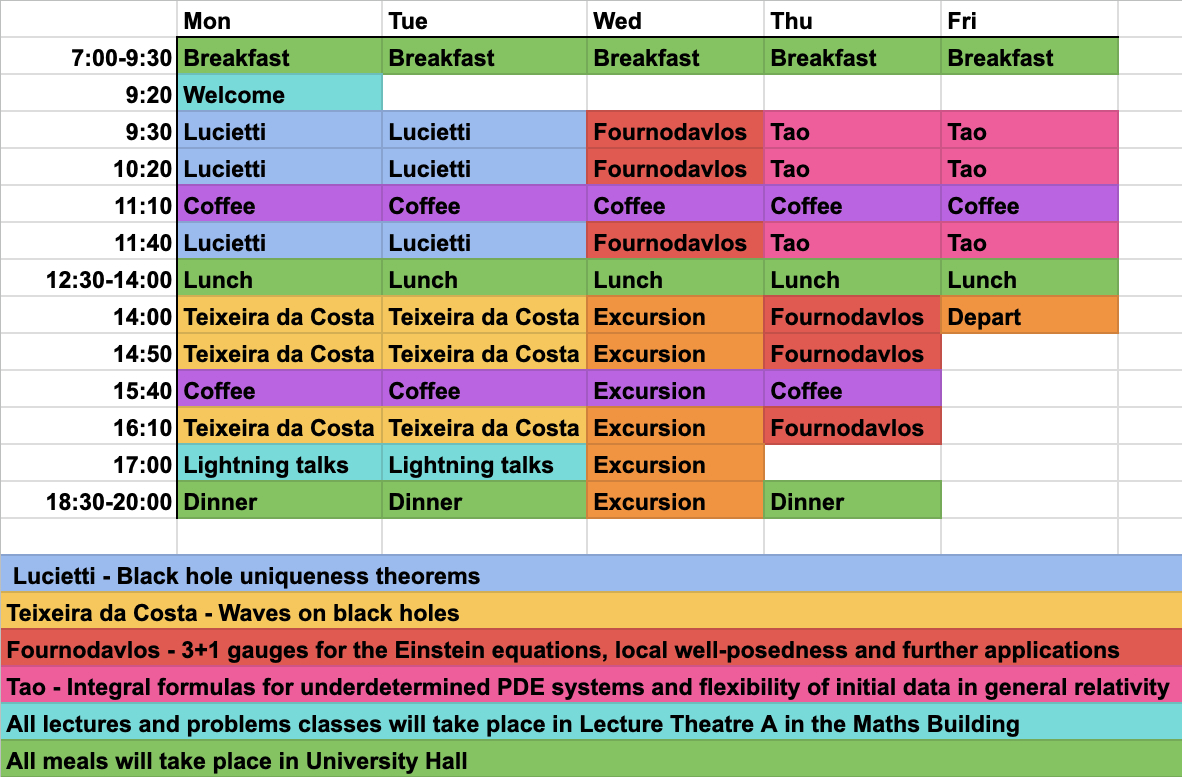
Sample Timetable
Funding
We are grateful for the financial support from the Glasgow Mathematical Journal Learning and Research Support Fund. We acknowledge support of the Edinburgh Mathematical Society. We acknowledge support from the Heilbronn Institute for Mathematical Research (HIMR) and the UKRI/EPSRC Additional Funding Programme for Mathematical Sciences.