Publications
You can find my recent publications through the Research Explorer.
Current research
My research interests range across lots of applied mathematics - and particularly more recently into data focussed methods and machine learning. I started my research career off in fluid dynamics and computational modelling, but that has diversified a lot. Seeking out new and interesting applications has led to me working in lots of interdisciplinary spaces - from medical imaging through to historical mapping and soil health. I particularly enjoy finding a niche for mathematics in these spaces across and between disciplines.
Students supervised or co-supervised:
- Anthos Makris
- Kendig Sham
- Constantijn Vleugels
- Anastasia Kozhevnikova
- Mae Evans
- Elle Smith
- Rebecca Wilks
- Tara Cunningham
- Jacob Connolly - "Characterising Bias and Noise in Interferometric Synthetic Aperture Radar Time Series"
- Jamie Burke - "Choroidal image analysis for OCT image sequences with applications in systemic health"
- Riki Herliansyah - "Efficient Model Fitting Approaches for Estimating Abundance and Demographic Rates for Marked and Unmarked Populations"
- Johannes Hansen - "Change detection in spatiotemporal SAR data for deforestation monitoring"
Past Post-doc and PhD research work

A dense gravity current
My research interests have encompassed a range of problems within applied mathematics. I am particularly interested in fluid dynamical phenomena. Within fluid dynamics my past research has principally been on inviscid stratified flows, however I also have interests ranging from Stokes' flow to non-Newtonian fluids.
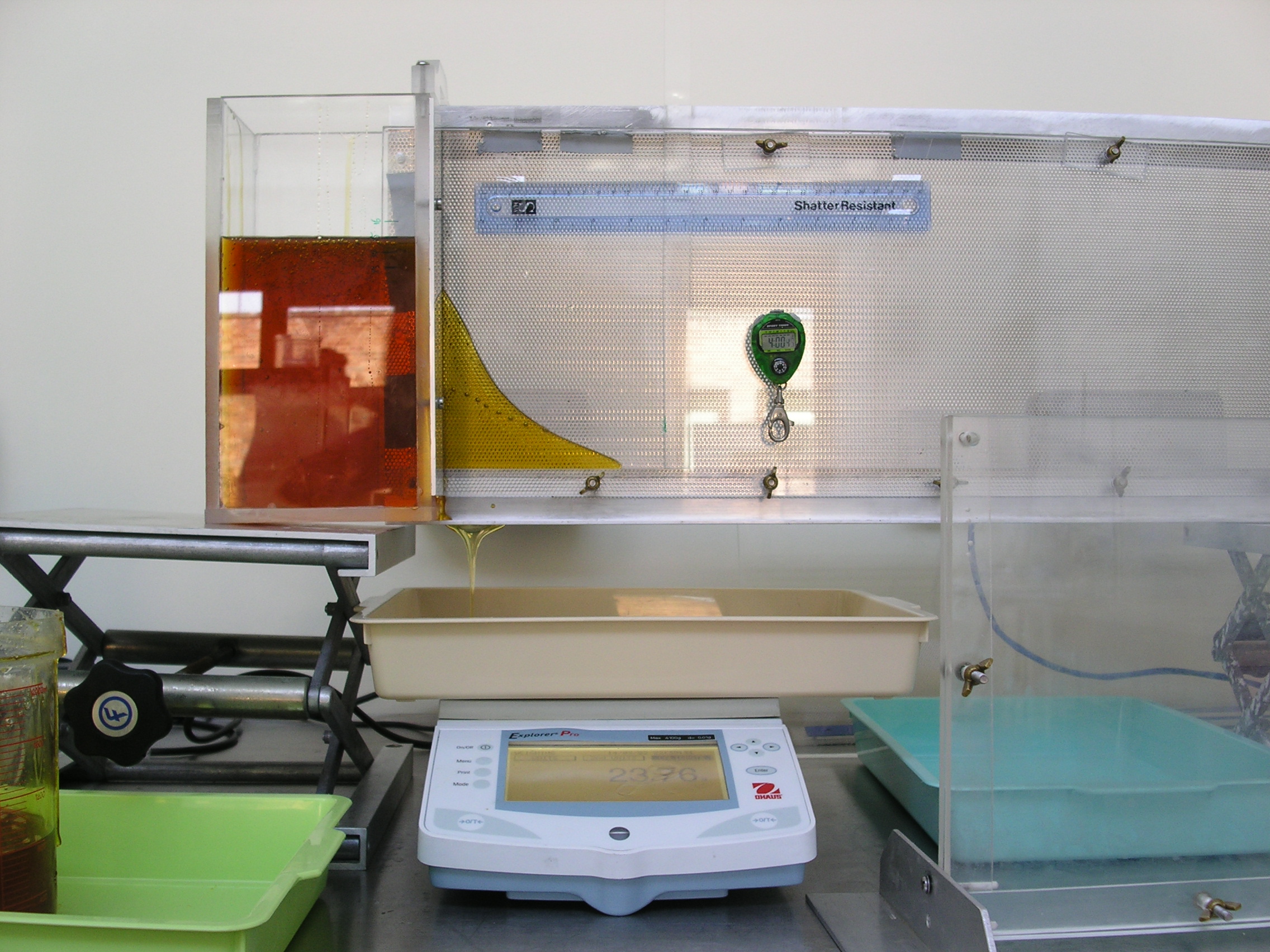
Viscous fluid flow under gravity through a leaky fracture
I began my research career studying flow through porous rock, and in particular flow through fractured rock. During my Masters thesis I worked on the flow of a gravity current of non-Newtonian fluid through a model fracture. After this in my PhD thesis I examined a range of viscous flows through leaky fractures. These flows modelled the spreading and slumping of a viscous fluid through a fracture adjacent to a porous layer, so that some fluid was lost to the layer from the fracture. These studies were done with a combination of experimental and analytical techniques. I also examined the problem of a viscous gravity current dipole flow through a channel. Some of the experimental photographs from this work can be seen below and right. More recently I have returned to flows through porous media and have become interested in non-Newtonian flows, particularly with a view to developing new numerical models for these.

Viscous dipole flow through a channel
The more recent focus of my research has been to develop and construct advanced numerical models for stratified flows. This has been joint work with David Dritschel, with whom I have developed a range of numerical schemes for dealing with such flows using contour based methods. David has a long history of developing and exploiting advanced computational techniques using contour methods, and we have been engaged in updating and extending the code base that he has developed over the years. This has led to a suite of codes applicable in a range of areas, including spherical shallow water models, stratified flows, quasi-Geostrophic flow and others.

Exhange flow
I am also particularly interested in internal solitary waves (ISWs), and their behaviour as they break. Such waves are supported across the pycnocline in the ocean and when they break can result in a significant amount of mixing. As part of a project working with Magda Carr as a PDRA I was able to visit the University of Oslo together with a PhD student James Franklin, to conduct some experiments with colleagues there in their large flume tank. Subsequently we have compared these measurements with numerical models of breaking ISWs.

A breaking internal solitary wave